






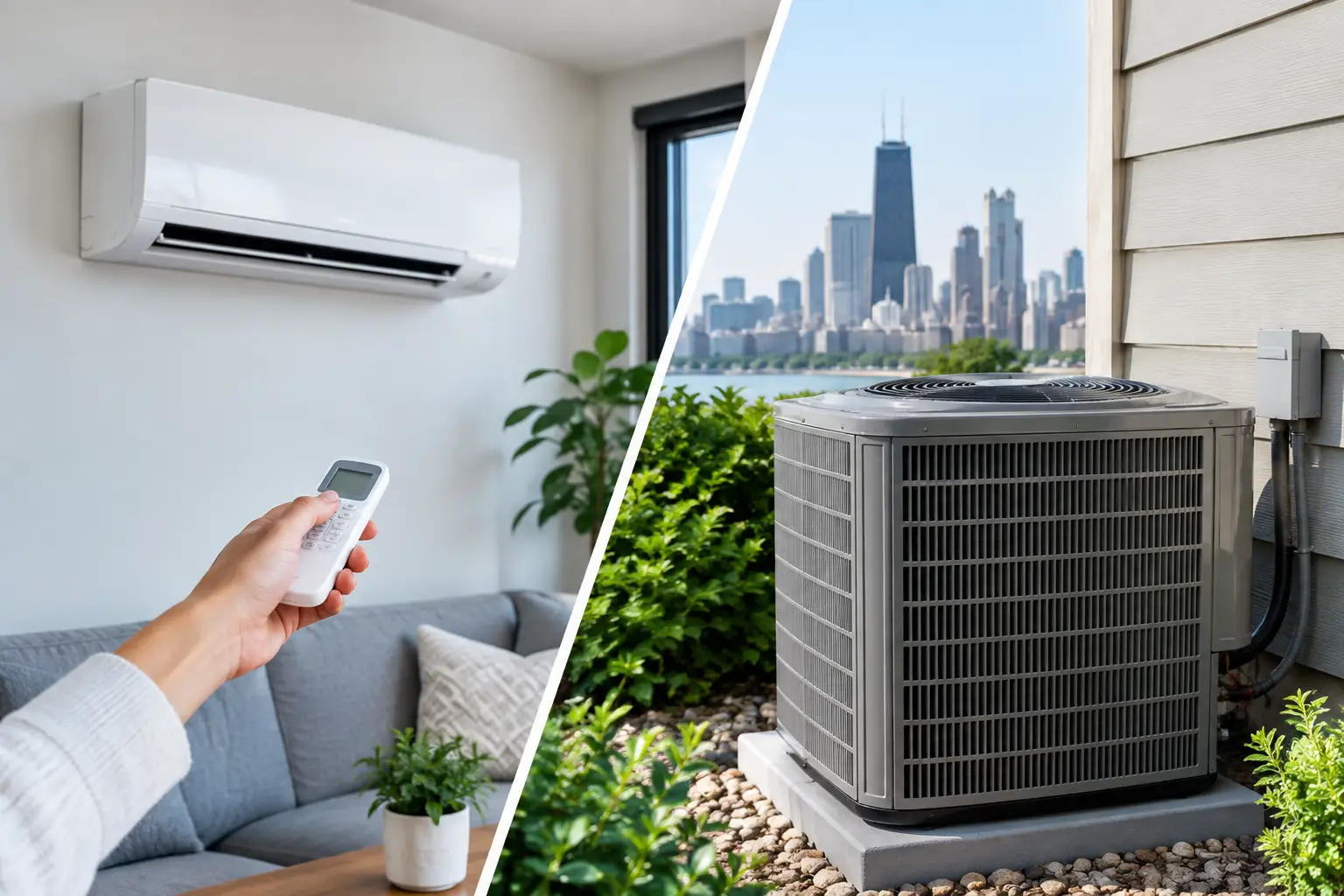
A cooling upgrade should solve the problems your home actually has: hot bedrooms, uneven temperatures, window units that cannot keep up, or an aging system that needs frequent repairs. When comparing ductless versus central air, the right choice depends less on a single “best” system and more on your home’s layout, existing equipment, comfort priorities, and long-term plans.
For many Chicago-area homeowners, the decision also has a heating connection. A home with a furnace and usable ductwork has different options than a vintage building with radiators or a boiler. A careful evaluation should account for both humid summer cooling and the demands of a Midwest winter.
Written by the Shad Heating & Cooling team
Ductless Versus Central Air: The Main Difference
Central air conditioning uses one outdoor unit and an indoor coil, typically installed with a forced-air furnace or air handler. Conditioned air moves through a network of supply and return ducts to cool the home. A properly designed central system can provide consistent whole-home cooling from a single thermostat or through added zoning controls.
Ductless systems, often called mini-splits, use an outdoor unit connected to one or more indoor air handlers. Each indoor unit serves a specific room or zone. Instead of sending cooled air through ductwork, the indoor unit delivers it directly into the space.
Neither approach is automatically better. Central air is often a natural fit for homes with sound existing ducts. Ductless equipment can be an excellent answer for additions, converted attics, enclosed porches, top-floor bedrooms, and homes where installing ducts would require major construction.
When Central Air Makes Sense
Central air is often the practical choice when a home already has a furnace and ductwork in good condition. The ducts are already reaching the rooms that need cooling, so the project can focus on correctly sizing and installing the cooling equipment rather than rebuilding the home’s distribution system.
It also works well for homeowners who prefer a less visible cooling setup. Registers sit in floors, walls, or ceilings, while the main indoor components are typically located near the furnace. There are no wall-mounted air handlers in occupied rooms.
Central air can be especially effective for whole-home comfort, provided the duct system is properly designed and maintained. Leaky ducts, undersized returns, poor airflow, and blocked registers can all undermine performance. Replacing an outdoor unit without addressing those issues may leave the same upstairs heat, humidity concerns, or uneven room temperatures in place.
For homes with forced-air heating, a central system also makes maintenance straightforward. The cooling equipment, blower, filtration, and ductwork function as connected parts of the same comfort system. Regular service helps protect efficiency, airflow, and equipment life.
Central air limitations to consider
Central air needs enough room for ducts, and the ducts must be able to carry the required airflow. This can be challenging in older homes that rely on boilers and radiators, or in properties where ducts were added later and do not adequately serve every room.
Ductwork can also become a significant part of the project if it needs extensive repair, resizing, or installation. In some homes, opening walls and ceilings to add ducts is disruptive enough to make a ductless approach more attractive.
When Ductless Air Conditioning Is the Better Fit
Ductless AC is a targeted solution. It can cool one difficult room or provide comfort across multiple zones without requiring a full duct system. That flexibility is valuable in Chicago’s older housing stock, where masonry construction, finished basements, and limited attic access can make new ductwork complicated.
A single ductless unit may be ideal for a third-floor bedroom that stays hot, a home office, a sunroom, or a new addition. Multi-zone systems can serve several areas from one outdoor unit, with each indoor unit controlled separately. That lets occupants set different temperatures in different areas instead of cooling every room the same way.
This room-by-room control can reduce wasted cooling in spaces that are rarely used. It may also help resolve comfort complaints caused by a home’s layout, such as a warmer second floor or a room exposed to strong afternoon sun.
Ductless heat pumps can provide both cooling and heating, which adds another layer to the decision. For a home without a furnace, a properly selected cold-climate heat pump may offer an efficient all-season comfort option. In severe winter weather, however, system selection, capacity, insulation, and backup heat planning all matter. Heating performance should be evaluated carefully rather than assumed.
Ductless limitations to consider
Indoor units are visible. While modern units are compact and quiet, placement should be planned around furniture, airflow, and the look of the room. A unit tucked behind a tall bookcase or aimed directly at a bed will not deliver the comfort it should.
Ductless systems also require regular filter cleaning and professional maintenance. Each indoor unit has its own components, so a multi-zone system needs attention in every zone. Proper installation is essential because refrigerant piping, condensate drainage, electrical connections, and line routing all affect reliability and appearance.
Comfort, Humidity, and Air Quality
Cooling is not only about lowering the thermostat. Chicago summers can bring high humidity, and excess moisture can make a home feel sticky even when the temperature seems reasonable. Both central and ductless systems can manage humidity when they are correctly sized and installed.
Oversizing is a common comfort problem. A system that cools the air too quickly may shut off before it removes enough moisture. That can leave rooms cool but clammy and create more frequent starts and stops. Accurate load calculations, not rules of thumb, help determine the right equipment capacity.
Central air can pair naturally with whole-home indoor air quality equipment, including upgraded filtration, humidification, dehumidification, and air purification. Ductless systems use filters in each indoor unit and can provide good localized filtration, but they do not use a central duct network for whole-home air treatment.
If allergies, dust, basement dampness, or inconsistent humidity are major concerns, discuss them during the system evaluation. The best cooling choice may include an indoor air quality recommendation, but it should be based on a documented need, not added by default.
Installation and Long-Term Ownership
The installation path matters as much as the equipment itself. A central air project may be relatively contained in a home with a compatible furnace and healthy ducts. In a home without ducts, it may require a more involved design and construction plan.
A ductless installation avoids major ductwork but still requires careful planning. Indoor and outdoor equipment locations, drainage, electrical capacity, and refrigerant line routing should be reviewed before work begins. Clean workmanship matters because these details affect both performance and how the finished installation looks in your home.
For landlords and small-business owners, serviceability is another consideration. A system should be accessible for routine maintenance and repairs without disrupting tenants or daily operations more than necessary. The lowest initial scope is not always the best long-term value if it leaves persistent comfort issues behind.
How to Choose With Confidence
Start with the parts of your home that are not working well. If the whole house has usable ductwork but suffers from weak airflow or an aging AC unit, central air may be the stronger path. If only a few rooms are uncomfortable, or adding ducts would be invasive, ductless may provide a more focused solution.
A professional assessment should include the home’s square footage, insulation, window exposure, room layout, electrical needs, existing heating equipment, duct condition, and comfort goals. It should also identify whether zoning, duct repairs, or humidity control could solve the problem without installing more equipment than necessary.
The most reliable recommendation is one that explains the trade-offs clearly: what the system will address, what it will not address, how it will be maintained, and why it fits the property. That transparency helps protect your comfort and your investment.
A well-planned cooling system should feel like a long-term improvement, not a temporary answer to another hot summer.
Frequently Asked Questions
Is ductless AC more efficient than central air?
It can be, especially when cooling only occupied rooms. Central air can also be highly efficient when ducts are sealed, sized correctly, and maintained.
Can a ductless system cool an entire house?
Yes, a properly designed multi-zone system can cool an entire home. The right layout and equipment capacity are essential for consistent results.
Does central air work with a boiler-heated home?
It can, but central air requires ductwork. Homes with boilers and radiators often choose ductless cooling when adding ducts would be too disruptive.
Which system is easier to maintain?
Both need professional seasonal service. Central systems involve the air handler and ductwork, while ductless systems need each indoor unit inspected and cleaned regularly.